 Ultimate guide
Victoria's Accident Towing Allocation System Explained
Last Updated: October 22, 2026
Quick Summary
The accident towing allocation system is Victoria's regulated framework that decides which tow truck attends a crash scene in designated areas, instead of leaving it to chance or whoever arrives first. An allocation body logs the job, matches it to a geographic zone and dispatches the licensed operator on duty for that zone.
- The system is not run by police and does not cover the whole state.
- Zones are drawn around depot boundaries, not suburb names.
- An unauthorised tow truck that turns up uninvited is not part of the dispatch.
- You retain choice of repairer; allocation governs who tows, not who repairs.
- Locked, undercover storage of an accident-damaged vehicle is charged at $31.60 per day.
Table of Contents
- What the Victorian Accident Towing Allocation System Is
- The Accident Towing Allocation Process, Step by Step
- Where the Allocation System Applies and Where It Does Not
- Who Allocates a Tow Truck: Police, Authorised Officers and the Allocation Body
- What to Do After a Car Accident: A Driver's Checklist
- Fees, Storage and Retrieving Your Vehicle
- Accident Towing Phone Number Victoria: Who to Call and When
- Frequently Asked Questions
What the Victorian Accident Towing Allocation System Is
The Victorian accident towing allocation system is the regulated framework that decides which tow truck attends a crash scene in designated areas, rather than leaving it to chance or whoever arrives first.
Here's the part most guides get wrong: the system is not run by police, and it does not cover the whole state. According to the Essential Services Commission's Accident Towing Fees Review 2025, jobs in covered areas are allocated by an allocation body, and there is no formal allocation system for the remainder of Victoria.
Below, we explain exactly how the accident towing allocation process works, who decides which truck attends, and what you should do in the first ten minutes after a crash.
Why the System Exists
Before allocation, crash scenes were a free-for-all. Multiple tow operators would converge on the same collision, and drivers under stress would sign authorisation forms without understanding the fee or where their car was going.
The allocation model replaces that scramble with a single dispatch decision. One job, one allocated operator. The practical benefit for you: no bidding war at the roadside, and a documented trail of who took your vehicle and where it went.
The Accident Towing Allocation Process, Step by Step
The allocation process follows a set sequence from the moment a crash is reported to the moment your vehicle leaves the scene. Here is how it runs in practice, and what each stage means for you.
- The collision is reported. A call to 000, a police report or a call to the allocation centre starts the job. If anyone is injured or a lane is blocked, emergency services attend first and the tow is arranged around them.
- The job is logged and zoned. The allocation body records the location and matches it to the correct geographic zone. Zones are drawn around depot boundaries, not suburb names, so a crash near a boundary can fall to a neighbouring zone.
- A licensed operator is dispatched. The allocation body contacts the operator on duty for that zone. You do not get to shop around within the system, the dispatch decision is made for you.
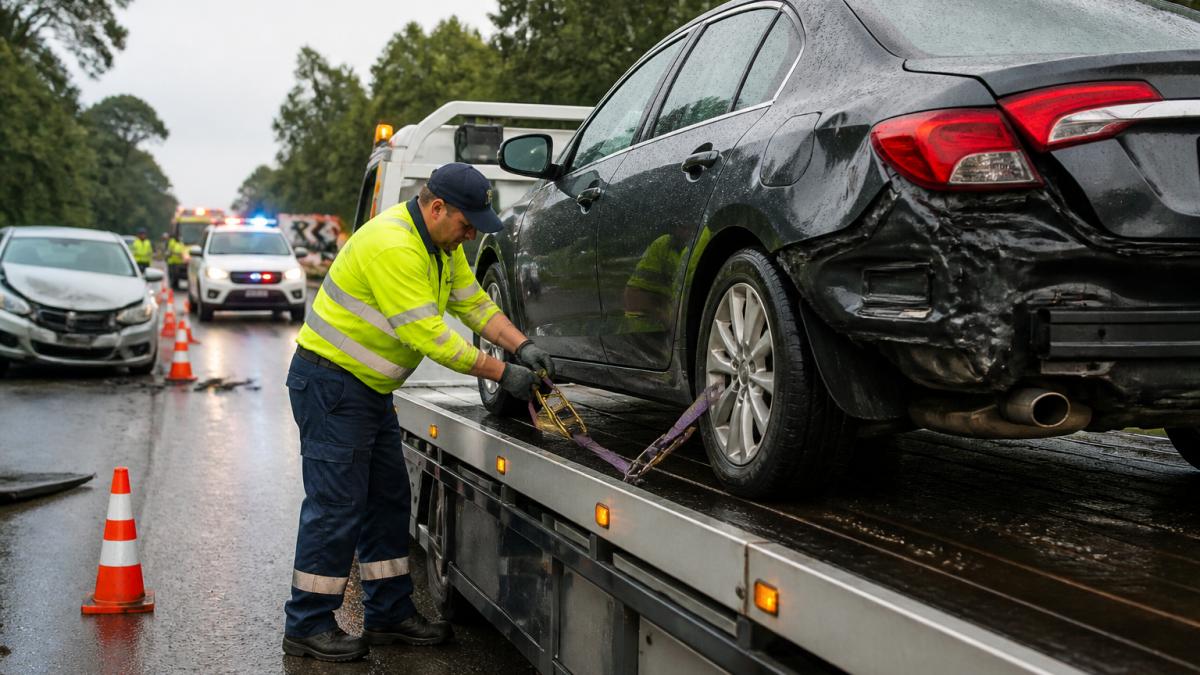
- The operator attends and secures the scene. The allocated truck positions safely, warns approaching traffic and loads the damaged vehicle without creating a second hazard.
- The vehicle is removed. It goes to a storage facility or, if you have nominated one, a repairer. The destination should be recorded on your paperwork.
- You receive documentation. You should be given the towing authority, the operator's details and the name and suburb of the storage facility.
What Happens at the Accident Scene
Attendance is where the rules matter most. The allocated operator is responsible for scene management: positioning safely, warning approaching traffic, and loading the damaged vehicle without creating a second hazard.
You still have rights at the scene. You can ask to see the operator's tow truck licence, confirm the name and suburb of the storage facility, and ask for the fee in writing before authorising removal.
Who Does What at the Scene
| Party | Role at the scene |
|---|---|
| Police and authorised officers | Control traffic, determine whether a vehicle must be moved, and can direct removal where a vehicle is a hazard |
| Allocation body | Logs the job, identifies the zone and dispatches the licensed operator |
| Allocated tow operator | Attends, secures the scene, loads the vehicle and provides towing documentation |
| You, the driver | Exchange details, document the scene, confirm the storage destination and keep the paperwork |
What most drivers miss is that you retain choice of repairer. The allocation system governs who tows your car, not who repairs it. You can ask for the vehicle to be delivered to a repairer you trust.
Where the Allocation System Applies and Where It Does Not
The allocation system applies within defined geographic zones, not across the entire state. Transport Victoria publishes an accident towing allocation map showing depot boundaries and contact details for the areas it covers.
The distinction matters if you break down outside a major centre. The benchmarking analysis from the Essential Services Commission notes that RACV is contracted to operate the call centre that allocates accident-towing jobs to operators.
| Location | Allocation system applies | What you do |
|---|---|---|
| Within a mapped allocation area | Yes, job dispatched by allocation body | Call the allocation centre or a coordination service |
| Outside mapped areas | No formal allocation system | Contact a licensed tow operator directly |
| Interstate | Different state rules apply | Check that state's regulator |
Who Allocates a Tow Truck: Police, Authorised Officers and the Allocation Body
Police and authorised officers control the scene, but they do not choose your tow operator in allocation areas. Their role is road safety and traffic management: closing lanes, directing traffic and determining whether a vehicle must be moved.
The dispatch decision sits with the allocation body.
What most drivers miss is that you retain choice of repairer. The allocation system governs who tows your car, not who repairs it.
What to Do After a Car Accident: A Driver's Checklist
Knowing what to do after a car accident comes down to a short, ordered list. Work through it in sequence, and the paperwork and the tow both become simpler.
- Stop, switch on hazard lights and check for injuries
- Call 000 if anyone is hurt or the road is blocked
- Move to a safe position behind a barrier if the vehicle can be moved
- Exchange names, licence details, registration and insurer with the other driver
- Photograph vehicle positions, damage and the surrounding road before anything is moved
- Note the time, location and weather conditions
- Call the allocation centre or a coordination service to arrange the tow
- Confirm the storage facility name and suburb before signing anything
Fees, Storage and Retrieving Your Vehicle
Towing and storage charges in allocation areas are regulated and published, which means you can check a figure rather than take it on trust. The Victoria Government Gazette notice for 2026-27 lists a charge of $31.60 per day for locked, undercover storage of an accident-damaged motor vehicle.
That daily figure is why retrieval speed matters. A car left in storage for a fortnight accumulates a meaningful bill, and the meter runs whether or not anyone has inspected the vehicle.
How to Retrieve Your Vehicle
Work through this in order and keep a record of each step:
- Contact the storage facility and confirm the outstanding charges in writing
- Provide identification and proof of ownership, registration papers, a purchase receipt or a finance statement
- Confirm whether your insurer has authorised release, or arrange payment yourself
- Ask for an itemised breakdown of towing and storage charges before paying
- Arrange collection or a transfer to your chosen repairer, and get the release in writing
- Keep every receipt and the towing authority for your records
If you are unsure who holds the vehicle, start with the allocation body for the zone and work back from the towing authority you were given at the scene.
If You Believe a Charge Is Wrong
Ask the operator for the itemised breakdown first, most disputes are about a charge that was never explained, not a charge that was never allowed. If the breakdown does not resolve it, raise the matter with the relevant regulator for accident towing in Victoria.
Accident Towing Phone Number Victoria: Who to Call and When
The right number depends on whether you are inside an allocation area and whether anyone is injured. For injuries or a blocked lane, call 000 first.
This is where Accident Assist Line fits. One call connects you to a real person, 24/7, with no call queues. We arrange the tow through the official allocation network, coordinate the repair, and liaise with your insurer on your behalf throughout the process.
Frequently Asked Questions
How does the accident towing allocation system work?
In covered areas, accident towing jobs are allocated through an allocation body rather than by the driver choosing a tow operator on the spot. Transport Victoria publishes allocation maps showing depot boundaries for Melbourne and Geelong. The 2025 Accident Towing Fees Review confirms there is no formal allocation system for the remainder of Victoria, so the process is not statewide.
Can I choose my own tow truck after an accident?
Where the allocation system applies, the tow is dispatched through the allocation body rather than selected by the driver at the scene. Outside those areas, the 2025 Accident Towing Fees Review confirms no formal allocation system operates.
What is the accident towing phone number in Victoria?
Transport Victoria's accident towing allocation map lists contact details for the allocation centre covering Melbourne and Geelong, along with depot boundaries for vehicles under four tonnes. Check the map for the number that applies to your location before you need it. If you are outside the allocation areas, the 2025 review confirms no formal allocation system applies, so you arrange a tow directly. Keep the relevant number saved in your phone.
What should I do if my vehicle is not safe to drive after a crash?
Move yourself and passengers to a safe spot away from traffic, call emergency services if anyone is injured, and do not stand between vehicles. If the car cannot be driven, it needs removal from the accident scene. In allocation areas the tow is dispatched through the allocation body. The vehicle is then taken to a storage facility. The 2026-27 Gazette notice lists $31.60 per day for locked, undercover storage of an accident-damaged vehicle, so ask where it is being taken and collect it promptly.
How much does accident towing and storage cost?
Accident-towing charges are regulated and reviewed by the Essential Services Commission, with annual charge notices published in the Victoria Government Gazette. The 2026-27 notice lists $31.60 per day for locked, undercover storage of an accident-damaged motor vehicle. Towing fees are set separately and published through the same regulatory process. Ask the operator for the applicable charge before the vehicle is moved, and keep the paperwork for your insurer.
How do I retrieve my vehicle after it has been towed?
Ask the operator or the allocation centre where the vehicle has been taken, then contact the storage facility to arrange collection. Bring photo identification and proof of ownership, and confirm the release process and any outstanding charges before you travel. The 2026-27 Gazette notice sets storage at $31.60 per day for locked, undercover storage, so daily charges accumulate. If you disagree with a charge, ask for it in writing and raise the matter with the operator first, then the relevant regulator.
A crash already disrupts your week. Chasing a tow, a storage release and an insurer across four phone calls should not add to it. Accident Assist Line arranges your tow through the official allocation network, coordinates the repair, and liaises with your insurer on your behalf, with a real person answering 24/7 and no call queues. Get started with Accident Assist Line and hand the coordination to someone who does it every day.