 ultimate-guide
Not at Fault Accident Claim Timeline Explained: 2026 Guide
Table of Contents
- What 'Not at Fault' Actually Means for Your Claim
- The Not at Fault Accident Claim Timeline, Stage by Stage
- How Long to Repair a Car After an Accident
- The Not at Fault Car Accident Procedure in Victoria
- How the Accident Towing Allocation Network in Victoria Works
- What Happens When the At-Fault Driver Is Uninsured or Disputes Liability
- If Your Claim Is Denied: The Appeal Process
- Frequently Asked Questions
Last Updated: September 28, 2026
What 'Not at Fault' Actually Means for Your Claim
Being not at fault means another driver's negligence caused the collision, so their insurer, not yours, should carry the cost. Fault is a legal determination about who breached their duty of care, not a moral judgment you make at the roadside.
The Not at Fault Accident Claim Timeline, Stage by Stage
The not at fault accident claim timeline typically runs from a few weeks to several months, depending on whether the other driver's insurer accepts liability quickly. Most of the delay sits in liability assessment, not repair work. What follows is the sequence as it actually unfolds, with the mechanisms that drive each stage and the points where claims stall.
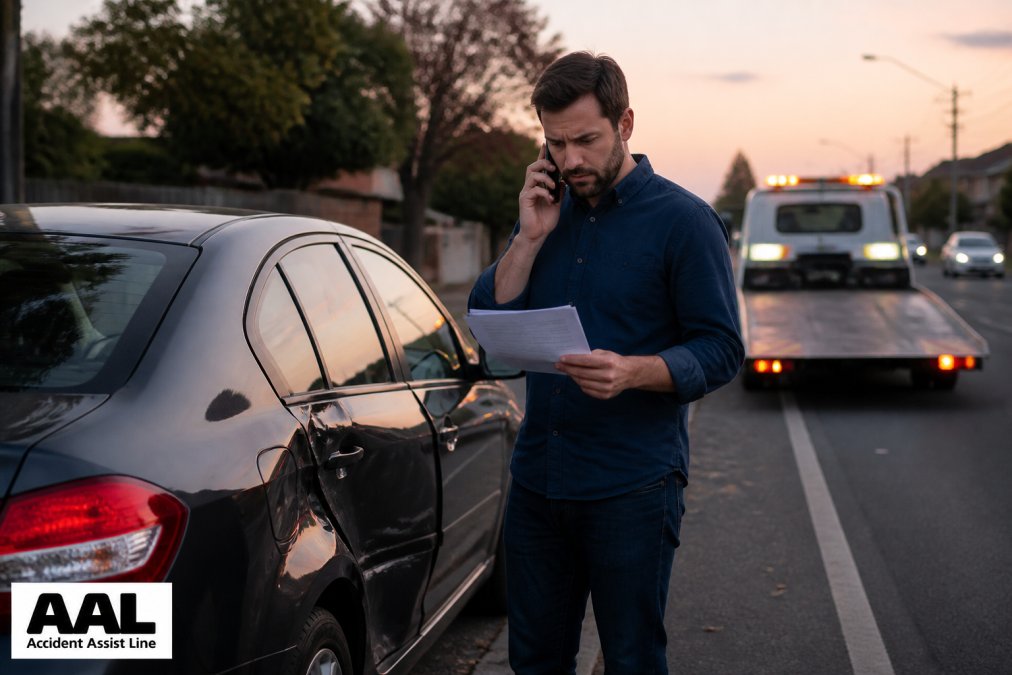
Stage 1: The first 24 hours at the accident scene
Secure the scene and call emergency services if anyone is injured. Exchange names, licence details, registration numbers and insurer details with the other driver. Photograph every vehicle from multiple angles, capture the road layout, and note the time and weather. Collect witness names and contact numbers before people leave. Report the matter to police if anyone was injured, if a driver failed to stop or exchange details, or if the damage is significant.
Stage 2: Notification, evidence and medical assessment
Notify your insurer promptly, even when you believe the other driver is at fault. Insurers generally expect notification within days, and delay gives them grounds to question the claim. Attend a doctor if you have any injury symptoms, however mild, and get a medical certificate documenting your injuries. Soft tissue injuries often present days later, so a same-day record matters.
Stage 3: Liability assessment and settlement
Liability assessment is where the timeline is won or lost. The at-fault insurer reviews the evidence and decides whether to accept liability. Once accepted, they arrange assessment of your vehicle and authorise repairs or a write-off payout. If liability is disputed, the process stalls and you may need to escalate.
- Evidence review, they compare your account against their driver's and any independent material. Conflicting accounts with no witness is the classic stall.
- Acceptance or partial acceptance, some insurers accept fault but contest the extent of damage, which is a different argument.
- Assessment, an assessor inspects the vehicle and either authorises repair or writes it off against a market value figure.
- Authorisation and repair, the workshop can only start once the authorisation lands.
Stage 4: Repair, return and finalisation
Once repairs are authorised, the workshop orders parts and schedules the work. Common damage runs one to four weeks; structural damage, rare imported parts and workshop queues extend it. When the vehicle is returned, check the repair against the original photographs before you sign anything, and keep the final invoice and any warranty paperwork.
How Long to Repair a Car After an Accident
Repair time after an accident usually falls between one and four weeks for common damage, though parts availability and workshop queues can extend it. Structural damage, rare parts for imported vehicles, and disputes over liability all push the timeframe out.
A practical sequence keeps things moving:
- Liability accepted by the other insurer
- Vehicle assessed by an approved assessor
- Repair quote authorised
- Parts ordered and panel work scheduled
- Repairs completed and vehicle returned
The Not at Fault Car Accident Procedure in Victoria
The not at fault car accident procedure in Victoria centres on evidence and prompt notification. Victoria runs a fault-based property damage system, so establishing the other driver's negligence is the whole game.
Steps that matter most:
- Report the accident to police where required, and obtain a police report reference.
- Notify your insurer within the timeframe your policy specifies.
- Lodge a claim with the at-fault driver's insurer, not just your own.
- Gather photographs, dashcam footage, witness statements and a medical certificate.
- Track every cost you incur, including towing and alternative transport.
How the Accident Towing Allocation Network in Victoria Works
Victoria's accident towing allocation network is a rotating system that assigns tow trucks to accident scenes so drivers are not left at the roadside negotiating with whoever arrives first. When you call for a tow after a crash, the allocation system dispatches the next available operator in the rotation.
What Happens When the At-Fault Driver Is Uninsured or Disputes Liability
An uninsured at-fault driver does not erase your right to recover, but it changes who you chase. You pursue the driver personally rather than an insurer, which usually means a letter of demand and, if that fails, a claim through the courts.
How you find out the other driver is uninsured
You often do not know at the scene. The other driver may give insurer details that turn out to be lapsed, or no details at all. The tell comes when you lodge a claim and the insurer responds that there is no policy in force for that vehicle or driver. At that point the claim shifts from an insurance process to a personal recovery process, and the burden of proof and enforcement sits with you.
The letter of demand, step by step
A letter of demand is a formal written request for payment. It is not a court document, but it is the step that most often produces a result without litigation. A workable demand includes:
- The date, location and circumstances of the collision.
- The other driver's details and vehicle registration.
- A clear statement of why you hold them liable.
- An itemised list of your losses, repair quotes, towing, hire car, and any out-of-pocket medical costs.
- A deadline for payment, commonly 14 to 28 days.
- A statement of what you will do if the deadline passes.
When liability is disputed
When liability is disputed, the other insurer is effectively saying the evidence does not establish their driver caused the crash. Common triggers include conflicting accounts, no independent witnesses, and unclear road layout. Strong evidence collection at the scene is what wins these arguments later.
Your own policy as a fallback
Check whether your own policy includes cover for damage caused by an unidentified or uninsured driver. Many comprehensive policies do, and using it does not necessarily mean you accept fault, but it can affect your no-claim bonus, so read the product disclosure statement before you decide. If you do claim on your own policy, your insurer may pursue the at-fault driver separately, which removes the recovery burden from you.
If Your Claim Is Denied: The Appeal Process
A denied claim is not the end of the matter. Insurers must give reasons for a denial, and you have the right to challenge a decision you believe is wrong.
The appeal path usually runs like this:
- Request the denial in writing with the specific reasons.
- Review whether they dispute fault, the damage assessment, or policy coverage.
- Submit a formal internal review with any additional evidence you have gathered.
- If the internal review fails, escalate to the relevant external dispute resolution body for the insurer.
Frequently Asked Questions
How long does it take to settle a non-fault claim?
There is no single timeframe. Straightforward property damage claims where the at-fault driver's insurer accepts liability can resolve in a few weeks, while claims involving injury, disputed liability or an uninsured driver take longer. Statutory time limits apply to lodging some claims, so report the accident and notify your insurer promptly. Keep every document, photo and receipt, because gaps in your evidence are what stretch a timeline out.
What steps should I take immediately after a not at fault accident?
Stop, make the scene safe and call emergency services if anyone is hurt. Exchange names, licence details, registration and insurer information with the other driver, photograph vehicle positions and damage, and collect witness statements. Report the accident to police where required, then notify your insurer. If your car cannot be driven, arrange a tow through the accident towing allocation network in Victoria rather than accepting an unsolicited tow.
Does a not at fault accident affect my insurance premium?
A not at fault claim should not affect your no-claim bonus or premium with most insurers, because the cost sits with the at-fault driver's insurer. Problems arise when liability is disputed or the other driver is uninsured, and your insurer pays then recovers later. Ask your insurer how it treats not at fault claims before you lodge, and keep your documentation ready in case the decision is questioned.
What is the difference between a repair coordination service and an insurance claim?
An insurance claim is the formal request for your insurer to cover damage or injury under your policy. A repair coordination service sits alongside it: it arranges the tow, books the repair and liaises with your insurer on your behalf. Accident Assist Line is a tow, repair and insurer-coordination service, so it does not manage, negotiate or settle claims, and it is not a claims advocate. You remain the policyholder.
How does the accident towing allocation network work in Victoria?
Victoria runs an official allocation system for accident towing, so when a tow is needed after a crash, the job is allocated to the next available licensed operator rather than whichever truck arrives first. This is designed to stop tow operators pressuring drivers at the scene. Accident Assist Line arranges your tow through this network, which means you get a legitimate operator instead of an unsolicited one.
How long does it typically take to process a not at fault vehicle repair?
Repair time depends on the damage, parts availability and whether the insurer has approved the quote. Minor panel damage can be booked in quickly once liability is accepted; structural damage or backordered parts add weeks. Ask the repairer for a written estimate and expected completion date, and confirm whether a hire car is covered while yours is off the road.